7 Common Dog Myths
Our knowledge about dogs has progressed lots in a relatively short period of time. This means that some of the things we think are facts are actually fiction!
Here are my top 7 dog myths…
1. Dogs Feel Guilt
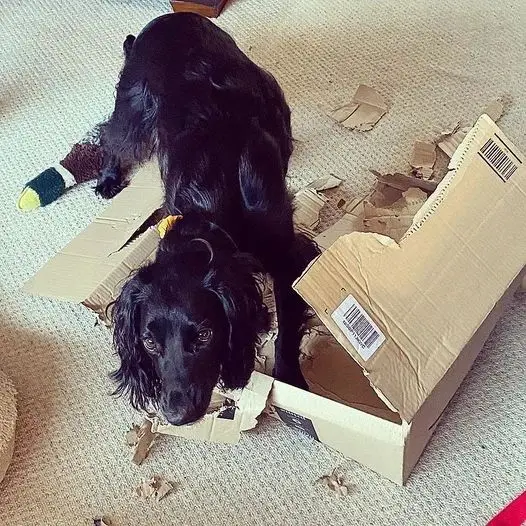
It can be easy to believe this when we see our dog’s big eyes looking up at us after they’ve chewed our favourite pair of shows. However, this isn’t because our dogs are feeling guilty. It’s because our dogs can sense we are unhappy with them and are trying to look submissive. It’s our reaction to their behaviour which results in them looking this way, rather than our dogs knowing they’ve done something wrong.
2. Dogs Understand ‘No’
Often our reaction to our dogs doing something we don’t like is to say ‘no’. However, dogs don’t automatically know what ‘no’ means- we would need teach them what this means.
No is also a very vague cue. What do we mean when we say ‘no’ to our dogs? It’s much better to be specific and ask your dog to do something they know already e.g. sit, touch, lie down, go to their bed.
3. Unneutered Male Dogs are More Aggressive and Have More Behaviour Problems
The research on this is fairly recent. It used to be believed that we should neuter male dogs early to prevent problematic behaviours and reduce aggression. However, neutering reduces testosterone, which reduces confidence levels, which can actually increase aggressive tendencies.
Every dog is different, so owners need to assess their own situation and what is best for them and their dog. Just don’t expect neutering to necessarily fix any of your dog’s undesirable behaviours!
You can learn more about male dog hormones in my handout here.
4. Dogs Shouldn’t be Allowed on Furniture
It used to be believed that if dogs were allowed on furniture, they would become ‘dominant’ and try to ‘rule the household’. This is absolutely not the case.
It’s a personal preference whether you decide to let your dog on the furniture. My small cocker spaniel is allowed to sleep in my bed and go on the sofa. However, if I had a big labrador and small children, I might not want my dog on the furniture.

5. We Should Walk Through Doorways Before Our Dogs
It used to be thought that we should always walk through doorways before our dogs so our dogs know who is ‘boss’. This is not true. You might still want to teach your dog some manners around doorways so they don’t run out without permission and don’t pull you through doorways to go for their walk, but it is not about showing them who is ‘boss’.
6. We Need to Show Our Dogs Who is the ‘Alpha’
One study in the 1960s argued that dogs are pack animals and we need to show them we are the ‘alpha’ dog in the pack. However, the 1960s study was based on observations of wolves in captivity- not even on dogs!
More recent research has shown that dogs are not pack animals and don’t need an ‘alpha’.
Instead, we should be a benevolent leader to our dogs, similar to parents to children, rather than a strict boss.
Find out more about dominance theory debunked in this blog post.
7. A Wagging Tail Means Our Dog is Happy
A waggy tail just means our dog is feeling aroused. This could mean they are happy, but could also indicate other less positive emotions.
We need to look at our dog’s body as a whole (not just the tail) to tell how they are feeling.
Did any of these myths surprise you?
Sign up to me email list for more information on dog training and a FREE guide to understanding your adolescent dog.
References
Hasegawa, M., Ohtani, N. and Ohta, M. 2014. ‘Dogs’ body language relevant to learning achievement’. Animals 4(1): 45-58.Hiby, E.F., Rooney, N.J. and Bradshaw, J.W.S. 2004. ‘Dog Training Methods: their use, effectiveness and interaction with behaviour and welfare’. Animal Welfare 13(1): 63-70.
Hiby, E.F., Rooney, N.J. and Bradshaw, J.W.S. 2004. ‘Dog Training Methods: their use, effectiveness and interaction with behaviour and welfare’. Animal Welfare 13(1): 63-70.
Kennel Club: Do Dogs Feel Guilt? Here’s What We Know About What Dogs Think (akc.org)
Mech, L.D. 1999. ‘Alpha status, dominance, and division of labor in wolf packs’. Canadian Journal of Zoology 77(8): 1196-1203.
Polo, G., Calderon, N., Clothier, S. and Garcia, R.D.C.M. 2015. ‘Understanding dog aggression: Epidemiologic aspects.’ Journal of Veterinary Behaviour 10(6): 525-534.
Schenkel, R. 1947. ‘Expression studies of wolves’. Behaviour 1: 81-129.