Why is My Dog Barking!?

Barking is a natural behaviour in dogs however it is a common problem I deal with as a dog trainer. When trying to reduce a dog barking, first we need to understand why they are barking (McGreevy, 2004).
Once we understand why, we have a better understanding of their emotional state and can then develop a plan to reduce their barking.
Here are some common reasons why dogs bark:

Warning
Does your dog bark at people walking past the window? Do they bark at the doorbell? Do they bark when they hear a loud noise?
Your dog is probably trying to tell you to ‘look out!’ Dogs are naturally social animals, so in the wild they would have barked to communicate danger (Pongracz et al., 2010).
Excitement
Some dogs bark when they are excited about something (Righetti, 2004). For example, at the start of a walk, when you return home from work, or when you get their favourite toy out.

Boredom
Some dogs bark when they are bored (Schipper et al., 2008). They are trying to tell you they need something to do! Try giving them a Kong, Lickmat or hiding some treats around the house for them to sniff out.
Attention-Seeking
This is one of the most common reasons for barking in domestic dogs. Often, it is unintentionally reinforced by owners (McGreevy, 2004).
Play
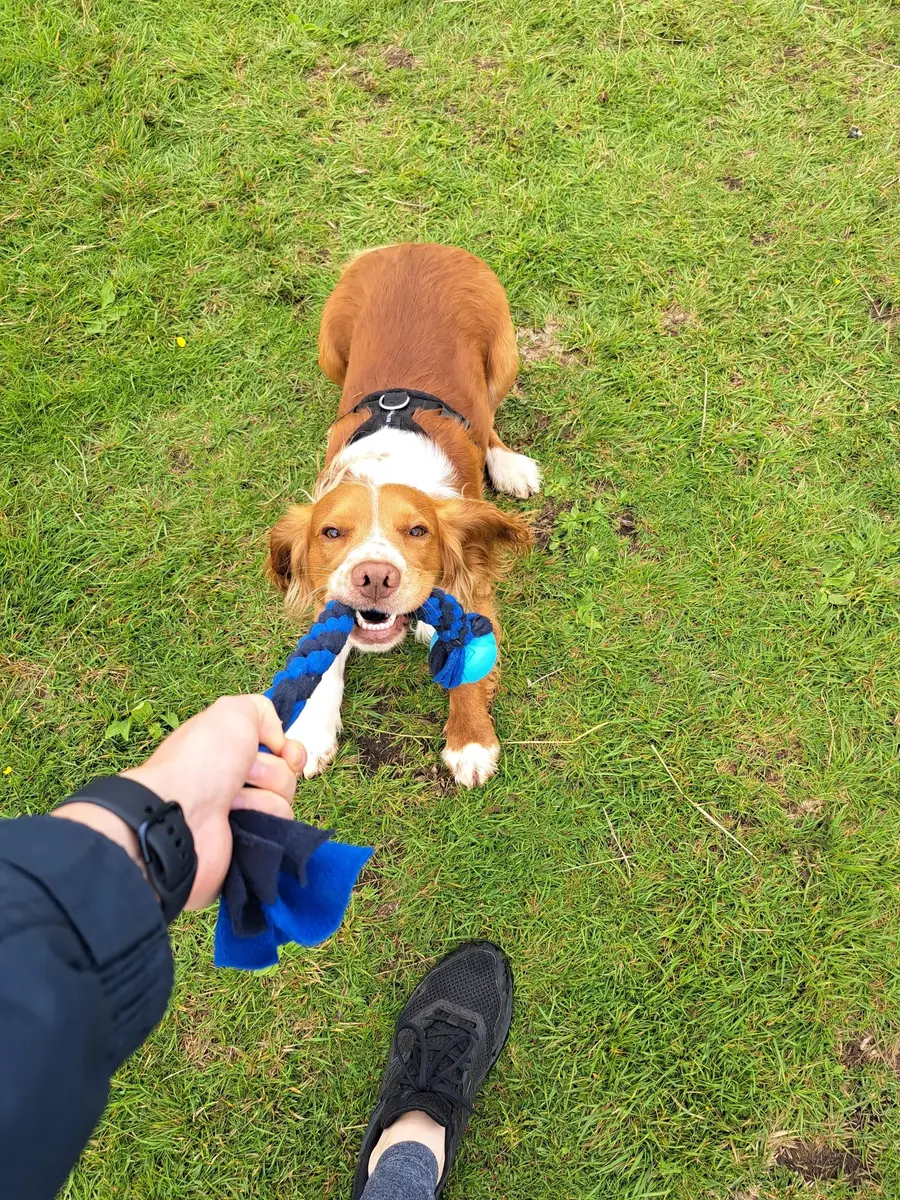
Some dogs bark during play (Pongracz et al., 2010). Look at their body language to tell if it is a friendly, excitable bark or if it is more fearful or aggressive. Loose, bouncy body language usually indicates play. Stiff body language usually indicates aggression. A tucked tail usually indicates fear (Gutteridge, 2019).

Anxiety/Fear
Does your dog bark at traffic? Or other dogs?
Maybe your dog is trying to protect themselves and thinks barking is the way to communicate this (Pongracz et al., 2009). Look at your dog’s body language for any signs of tension or anxiety (Gutteridge, 2019).
Separation Anxiety
Barking when left alone can be a sign of separation anxiety (Horwitz, 2009). Your dog is barking because they are anxious and this is how they are communicating their emotions.
Habit
Often dogs start barking for one of the above reasons, however the behaviour then becomes a habit and they bark even though they no longer feel that emotion.
This is usually the hardest type of barking to stop as this has become your dog’s automatic response to a stimulus (Righetti, 2004).

Get to know your dog’s barks. Dogs have different kinds of barks depending on their emotions. Usually low pitched barks are more aggressive, while high pitched barks tend to be more fearful or can be playful (Pongracz et al., 2006). The gaps between individual barks can also indicate what your dog is feeling (ibid, 2006).
Instead of just getting annoyed at your dog’s barking, get to know their barks so you can listen to them!
Once you understand why your dog is barking, you can then think about how to prevent them from needing to bark in the first place!
For example, make sure your dog has plenty of activities to do to prevent them becoming bored and feeling the need to bark. Or work on improving your dog’s confidence and de-sensitising them to things they are scared of.
Why is your dog barking…?
References
Gutteridge, S. 2019. Canine Communication: The Language of a Species.
Horwitz, D.F. 2009. ‘Separation-related problems in dogs and cats’ in BSAVA Manual of Canine and Feline Behavioural Medicine (pp. 146-158). BSAVA Library.
McGreevy, P. 2004. ‘Ethology of barking- why do dogs bark?’ Proceedings of the National Urban Animal Management Conference pp.9-10. Adelaide.
Pongracz, P., Molnar, C. and Miklosi, A. 2006. ‘Acoustic parameters of dog barks carry emotional information for humans’. Applied Animal Behaviour Science 100: 228-240.
Pongracz, P., Molnar, C. and Miklosi, A. 2010. ‘Barking in family dogs: an ethological approach.’ The Veterinary Journal 183(2): 141-147.
Righetti, J. 2004. ‘Barking up the wrong tree: the importance of understanding and correct diagnosis’ of barking in dogs’ in Proceedings of the National Urban Animal Management Conference pp.13-14. Adelaide.
Schipper, L.L, Vinke, C.M., Schilder, M.B. and Spruijt, B.M. 2008. ‘The effect of feeding enrichment toys on the behaviour of kennelled dogs’. Applied Animal Behaviour Science 114: 182-195.