7 Easy Exercises for a Calm Dog
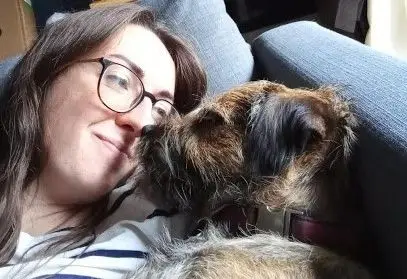
It is important to encourage calmness in our dogs. We do not want a dog who is constantly bouncing everywhere looking for attention!
Reward your dog whenever you see them being calm and encourage calmness to prevent them become over-excited.
Here are some simple calming exercises you can try…
1. Scatter Feeding
Sniffing is a naturally calming behaviour for dogs (Duranton and Horowitz, 2019), so we can encourage this to promote calm behaviour.
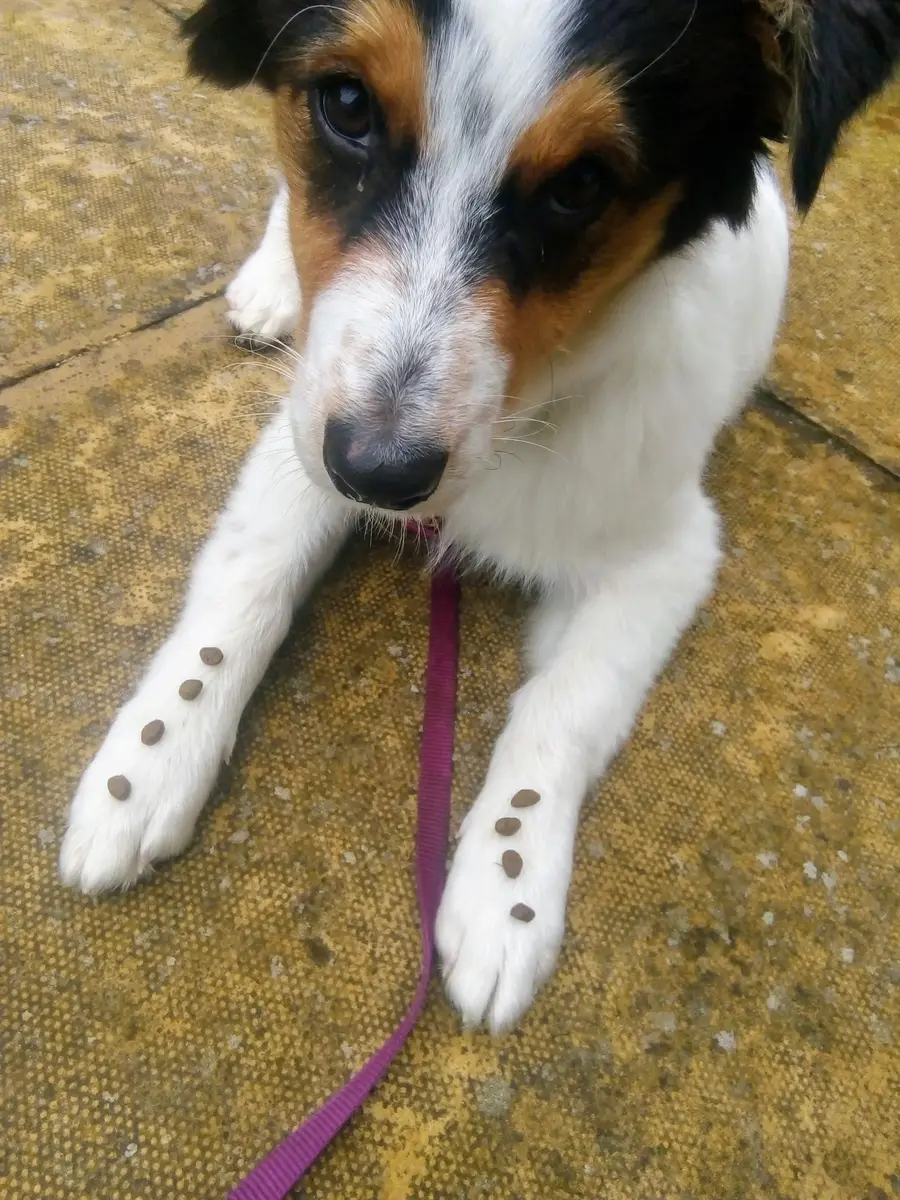
Scatter some small treats on the floor and encourage your dog to sniff them out.
Make it easy at first, then as they get used to the game you can make it harder. Try spreading the treats out more or doing it on different surfaces and in different places. Grass can be a great place for this game as your dog has to work a bit harder to sniff out the treats!
You can even take some of their kibble from their meals and do this game as part of their meal. It encourages dog’s natural foraging behaviours (Hare and Woods, 2013) and will tire them out a lot more than just feeding them straight from their bowl.
2. Find the Treat
Similar to scattering the treats, this game uses your dog’s nose to encourage them to be calm (Duranton and Horowitz, 2019).
Take a treat and hide it somewhere. Make it easy at first, then progressively increase the difficulty. You can even start hiding it in different rooms around your house, or hide it in/under/behind things!
3. Watch Me
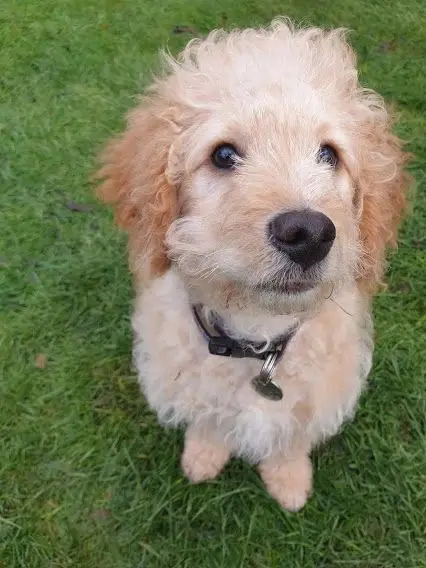
Ask your dog for a sit, then hold a treat up next to your eye. This will encourage your dog to make eye contact with you. The moment they make eye contact, say ‘watch me’ and give them the treat.
Gradually increase the time they hold eye contact before you give them the treat.
This encourages bonding between you and your dog (MacLean and Hare, 2015). It also encourages them to pay attention to you.
As well as a calming exercise, you can use this when out and about on walks when there are lots of distractions.
4. Touch
Hold your hand with your fingers pointing down, palm towards your dog, close to your dog’s nose. Encourage your dog to put their nose on your palm. The moment they do say ‘touch’ and treat them from the other hand.
If you are struggling with this, you can hold a treat between the fingers of your ‘touch’ hand. Your dog will automatically put their nose to you hand to get the treat.
Once your dog can do this, you can increase the distance between their nose and your hand. You can also put your hand at different heights.
This is also a useful command for when you are out on walks where there are a lot of distractions, because it helps your dog focus on you (Battersea, 2020).
You can also use this command for recall, encouraging your dog to come and do ‘touch’ rather than just giving them the recall command can be more fun for them.
5. In Your Bed
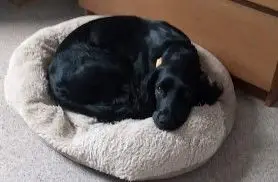
Teach your dog to go in their bed and stay there.
Start by luring your dog into their bed with a treat. Then give them a treat when they are in their bed. Drop treats on heir bed to reward them for staying there. Gradually increase the time between treat drops (Dogs Trust, 2019).
You can easily do this one while watching TV or working! Just move your dog’s bed by your feet and drop treats regularly to encourage them to stay there.
6. Kongs/Lick Mats/Snuffle Mats/Chews
These tools naturally encourage calmness through licking, sniffing and chewing (Rooney et al., 2019).
Try different types and fillings to find out what your dog’s favourites are.
Good fillings include: cream cheese, mashed banana and peanut butter (make sure it is doggy friendly!).
You can also look at these recipes from Blue Cross if you want to make your own fillings: https://www.bluecross.org.uk/pet-advice/top-10-kong-recipes-for-dogs
7. Basic Commands
Work on your dog’s basic commands e.g. sit, lie down, paw.
Work on the three Ds (distance, duration, distraction) to improve their commands (Greenebaum, 2010).
Try teaching them the commands without words, only hand signals (Mills, 2005).
This will help to use their mental energy, helping to make them calmer.
References
Battersea, 2020. Teach Your Dog a Nose ‘Touch’. https://www.battersea.org.uk/pet-advice/dog-advice/teach-your-dog-nose-touch
Dogs Trust, 2019. Teaching Your Dog to Settle. https://www.dogstrust.org.uk/help-advice/training/training-factsheets/teaching%20your%20dog%20to%20settle.pdf
Duranton, C. and Horowitz, A. 2019. ‘Let me sniff! Nosework induces positive judgement bias in pet dogs’. Applied Animal Behaviour Science 211: 61-66.
Greenebaum, J.B. 2010. ‘Training dogs and training humans: Symbolic interaction and dog training’. Anthrozoos 23(2): 129-141.
Hare, B. and Woods, V. 2013. The Genius of Dogs: Discovering the Unique Intelligence of Man’s Best Friend. Simon and Schuster.
MacLean, E.L. and Hare, B. 2015. ‘Dogs Hijack the Human Bonding Pathway’. Science 348(6232): 280-281.
Mills, D.S. 2005. ‘What’s in a word? A review of the attributes of a command affecting the performance of pet dogs’. Anthrozoos 18(3): 208-221.
Rooney, N., Gaines, S. and Hiby, E. 2009. ‘A Practitioner’s Guide to Working Dog Welfare’. Journal of Veterinary Behaviour 4(3): 127-134.